HPD API v1.2
A free, public HTTP API for decoding raw network packets using the Wireshark/tshark engine. No authentication required.
Introduction
Hex Packet Decoder exposes a REST API at /api that accepts a raw hex packet
and returns a full protocol dissection in XML (PDML), plain text, or PNG image format.
All requests are simple GET calls — no API key, for reasonable use only (100 requests maximum per hour).
Endpoint
GET https://hpd.gasmi.net/apiParameters
| Parameter | Required | Values | Description |
|---|---|---|---|
data | Yes | hex string | Raw packet bytes in hex. Accepts raw hex, spaced hex, tcpdump/Wireshark dump formats. The packet must start with an Ethernet header unless force is set. |
format | No | xml (default)textfilepng |
xml — PDML XML, inline in the response.text — plain text tree (equivalent to tshark -V).file — PDML XML as a downloadable attachment.png — a PNG image of the hex map.
|
force | No | ipv4ipv6 |
Treat data as a raw IPv4 or IPv6 payload with no Ethernet header. HPD prepends a dummy 14-byte Ethernet header automatically. |
Response: XML (PDML)
The default response wraps standard
PDML
output with an <hpd_info> metadata block at the top of the
<pdml> element.
hpd_info fields
| Field | Description |
|---|---|
bytes | Normalised hex bytes that were decoded (including any prepended dummy Ethernet header) |
force_ipv4 | True if force=ipv4 was used |
force_ipv6 | True if force=ipv6 was used |
time_ms | Server-side decoding time in milliseconds |
request_error | True if the request itself was invalid |
packet_error | True if tshark could not parse the packet |
hpd_version | HPD version string |
Example XML response
<?xml version="1.0" encoding="utf-8"?>
<pdml version="0" creator="hpd.gasmi.net" …>
  <hpd_info>
    <bytes>000000000000000000000000080045000028…</bytes>
    <force_ipv4>True</force_ipv4>
    <force_ipv6>False</force_ipv6>
    <time_ms>374</time_ms>
    <request_error>False</request_error>
    <packet_error>False</packet_error>
    <hpd_version>4.1</hpd_version>
  </hpd_info>
  <packet>
    <proto name="eth" showname="Ethernet II, Src: …" size="14" pos="0">
      <!-- field elements … -->
    </proto>
    <proto name="ip" …> … </proto>
    <proto name="udplite" …> … </proto>
  </packet>
</pdml>
Response: Text
With format=text, the response is a plain-text protocol tree identical to
tshark -V output — useful for quick inspection or logging.
Frame 1: 60 bytes on wire (480 bits), 60 bytes captured (480 bits)
    Encapsulation type: Ethernet (1)
    Arrival Time: Jul 14, 2020 01:58:36.000000000 CEST
    …
Ethernet II, Src: 00:00:00_00:00:00, Dst: 00:00:00_00:00:00
    Type: IPv4 (0x0800)
Internet Protocol Version 4, Src: 139.133.204.176, Dst: 139.133.204.183
    Version: 4
    Header Length: 20 bytes
    Total Length: 40
    Time to live: 64
    Protocol: UDPLite (136)
    Source: 139.133.204.176
    Destination: 139.133.204.183
Lightweight User Datagram Protocol, Src Port: 32768, Dst Port: 1234
    Source Port: 32768
    Destination Port: 1234
    Checksum: 0xf53f
Data (12 bytes)
0000  68 65 6c 6c 6f 20 77 6f 72 6c 64 0a   hello world.
Response: PNG
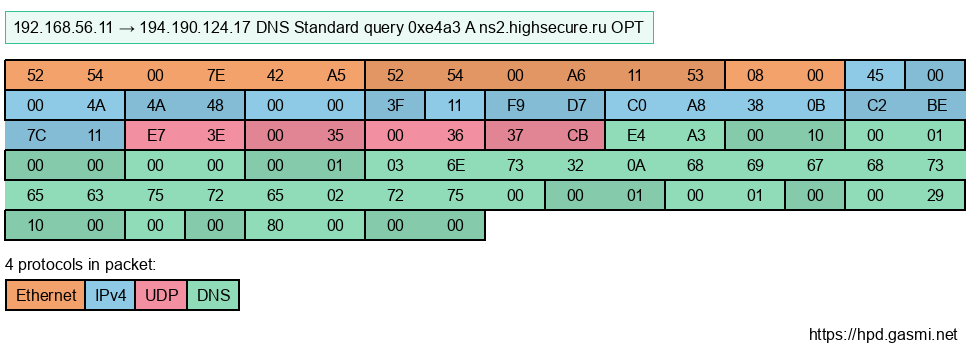
With format=png, the response is a PNG image of the hex map with the protocol
legend — the same graphic shown on the main interface. Useful for embedding in reports or
documentation.
Examples: curl
IPv4 + UDPLite payload, default XML output
curl "https://hpd.gasmi.net/api?force=ipv4&data=4500002852924000408837498B85CCB08B85CCB7800004D2000CF53F68656C6C6F20776F726C640A000000000000"Plain text output
curl "https://hpd.gasmi.net/api?force=ipv4&data=4500002852924000408837498B85CCB08B85CCB7800004D2000CF53F68656C6C6F20776F726C640A000000000000&format=text"Download as PDML file
curl -O -J "https://hpd.gasmi.net/api?force=ipv4&data=4500002852924000…&format=file"Download as PNG
curl -o packet.png "https://hpd.gasmi.net/api?force=ipv4&data=4500002852924000…&format=png"Examples: Python
Decode and walk the PDML tree
import requests, xml.etree.ElementTree as ET

hex_data = "4500002852924000408837498B85CCB08B85CCB7800004D2000CF53F68656C6C6F20776F726C640A000000000000"

r = requests.get("https://hpd.gasmi.net/api", params={
    "data":  hex_data,
    "force": "ipv4",
})

root = ET.fromstring(r.text)

# Print top-level protocol names
for proto in root.find("packet").iter("proto"):
    print(proto.get("name"), "→", proto.get("showname"))
Check for errors
info = root.find("hpd_info")
if info.findtext("request_error") == "True":
    raise ValueError("HPD: bad request")
if info.findtext("packet_error") == "True":
    raise ValueError("HPD: could not decode packet")
Examples: JavaScript
Fetch and parse XML
const params = new URLSearchParams({
  data:  "4500002852924000408837498B85CCB08B85CCB7800004D2000CF53F68656C6C6F20776F726C640A000000000000",
  force: "ipv4",
});

const res  = await fetch(`https://hpd.gasmi.net/api?${params}`);
const text = await res.text();
const xml  = new DOMParser().parseFromString(text, "text/xml");

const error = xml.querySelector("request_error")?.textContent;
if (error === "True") throw new Error("HPD request error");

xml.querySelectorAll("packet > proto").forEach(proto => {
  console.log(proto.getAttribute("name"), proto.getAttribute("showname"));
});HPD by Salim Gasmi — packet decoding powered by Wireshark / tshark — hpd.gasmi.net